My Dad and his Homing Pigeons
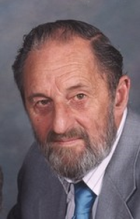
Because of my interest in science, I had some curiosity about how homing pigeons were able to navigate journeys of hundreds of miles to make their way home, but showing interest in the pigeons quickly resulted in becoming a "pigeon slave." The care and feeding of all of those pigeons was a major job, and most of it fell on my oldest brother Joe, who was a year younger than me. For awhile, I tended the birds, but after several days of pointing out to my father a bird that I particularly liked only to find it dead in a day or two, dad ended my duties, I think, convinced I had an evil eye. Looking back, I suspect that something about the bird's behavior, indicating its impending doom, brought it to my attention. Whatever the reason, I was spared the daily grind of tending the birds and instead shoveled manure from pens once a year and helped shell corn for the birds during those years dad decided to grow his own feed. The pigeon duties were eventually passed on to our siblings--and sometimes, my mother. (My great-grandmother decided the family name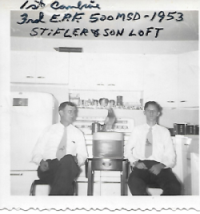
was actually spelled with a double f. My father
refused to change his name because "it was
on his birth certificate with one f." The rest of the
family made the change.)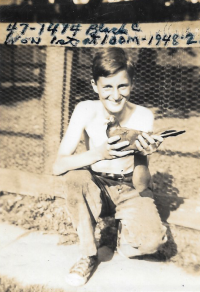
AU 47 YCC 1414 Black cock,
one of only two day birds
Dad's father, William Henry Snyder Stiffler, known by most as Snyder, also raised and flew homing pigeons and was the source of dad's interest. According to a story, dad decided to raise his own birds and tried to capture a barn pigeon, only to fall and break his leg. After that incident, my grandfather gave my dad a few birds to start his own loft. That experience may also explain dad's disdain for barn pigeons. After he married my mother, they were living on my maternal grandparents' farm. My dad was outside watching his flock flying over while standing with my grandfather. Dad swore a barn pigeon had infiltrated the flock. My grandfather expressed his doubts, and my dad told him he would prove it and got his rifle. "You're going to kill your own birds," my grandfather told him. "No, I'm not," and dad took a bead on a bird in the flock and fired. He retrieved the dead bird and showed my grandfather that it lacked a band, proving it was a "barnie."
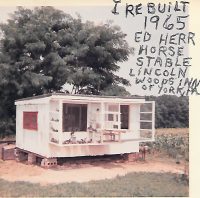
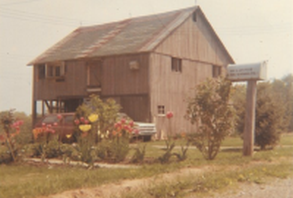
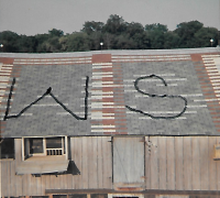
Pigeons are banded shortly after birth with a metal band slipped over the foot. Dad purchased bands from the American Racing Pigeon Union (bands marked AU) and kept careful records of each bird's ancestry and offspring. Later he bought bands from the International Federation of American Homing Pigeon Fanciers, Inc. (IF). In 1960, my parents moved to a farm in Lower Windsor Township, PA, where my mother still lives. Dad liked the location because the farm had a clear view to the south and south west, and had an old tobacco barn. Dad built a loft on the second floor and eventually added a corn crib to the bottom floor. He put a new roof on the barn working his initials into the pattern, claiming it would help his pigeons find their way home. This became quite a joke with the local farmers. To be honest, I don't know whether my dad was joking or was serious. In 1965, he rebult a stable and set it up in the back yard for his young bird flyers.
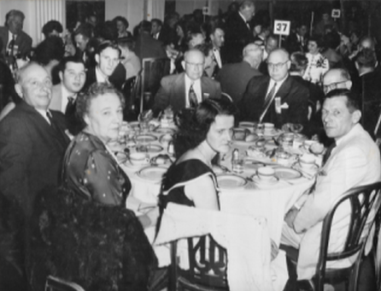
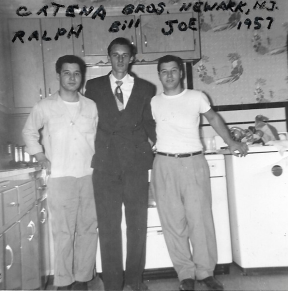
Pigeon racing is not a solitary activity, and dad knew a lot of local and regional pigeon fanciers. The local clubs included dad and his father (and, for awhile, my brother Joe), Don Otto, Wendle Ehrhart, Jim Badders, and Fred Grove. There were others whose names I don't remember. There was also a Smeltzer in Wrightsville who flew racers. Bill Lauterback of Long Harbor, MD, also taught dad things about breeding, feeding, and training pigeons. Dad also often mentioned Joe Catena from Newark, NJ. At one of those conventions, dad attended with my mother, the waiter came by to ask everyone for their drink order.
Dad knew nothing about liquor, but if he came to visit you, and you offered him his choice between, say, apple, cherry, and pumpkin pie, his response would be, "Duke's Mixture," that is, a piece of each.
So when the waiter came to him, he said, "I'll have a 'Duke's Mixture'."
"I've been a bartender for years, and I have never heard of that drink."
"It's a mixture of everything you have in the house."
Of course, at this point, everyone at the table began kidding him about it, so Dad had to show them up. The bartender brought him a glass with a little bit of everything in the house, and Dad, with no experience drinking, downed it like it was a soft drink. It wasn't long before he began to feel the effects, but when the waiter came to refill his drink, his pride would not let him do anything but have another glass. The second glass, however, he nursed, until finally, he "threw up." Dad never drank hard liquor again, for which I am eternally grateful. Dad suffered most of his life from paranoid schizophrenia and bipolar disorder. Adding alcohol to that Duke's mixture might have been fatal for us all.
Dad would often tell stories about various pigeons, pigeon races, and people who flew pigeons. I would come home to Pennsylvania from Tennessee, and dad would keep me up all night talking until he went to work, and then start the conversation again when he came home. He didn't just talk about pigeons although that was a common topic. He also talked about work, hunting, his ducks, the deer he was feeding, the garden, and people whom he felt had done him wrong as well as complaints about the neighbors, my siblings and, eventually, our offspring. One year, it occurred to me that I should take notes on his pigeon stories, thinking I might be able to use details in some fiction. Dad caught me and never told me another thing about pigoens. "I'm taking my secrets to the grave." He had told me once, years before, his methodology for successfully inbreeding, but I think I will take that information to my grave since I know he would not want me to share it.
Dad ran heavy electrical cables from the house to the barn so he could have lights in the pens. When I received a crystal radio set for Christmas, I ran the 50 foot antenna between the electrical cables. Dad fussed at first, claiming his pigeons might hit the wire, but I pointed out that, before they hit my wire, they would hit the electrical cables, so he let it go. One day while I was shoveling manure in the flyers pen, I looked out and saw a pigeon suddenly flip flop in the air, falling several feet before catching itself and flying normally. Worried that it had struck the wires, I told my dad. "Oh, that's a Holy Roller," which was my introduction to tumblers--and Pentecostalism.
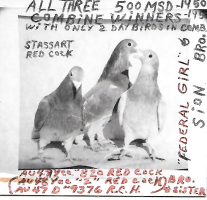
the only day birds in the combine. Federal Girl
(AU 47 D 9376 R.C.H.), Sion brother (AU 48 YCC 2),
Stassart Red Cock (AU 47 YCC 820)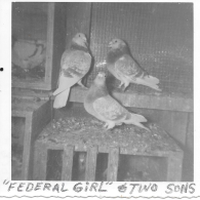
One of dad's early winners that became an important part of his breeding stock was Federal Girl, which his father bought from Charles Koon for Dad's high school graduation. Her previous owner gave her that name because, whenever she returned from a race, she would fly over the Federal Bank building on her way to the loft. Federal Girl and the other two 1950 500 mile winners appeared on the cover of the February 1951 Racing Pigeon News.
Dad also had a number of Vindication birds who won races. His original Vindication stock was purchased from John Mahaffey's loft, from whom he also purchased Sion, Stassart, and Bastin stock. Dad did not believe in vaccinating his birds, and he had enough birds that he could risk the chance of some disease. He was a firm believer in his sense of survival of the fittest. However, he did add honey to the birds' water and also sometimes added iodine.
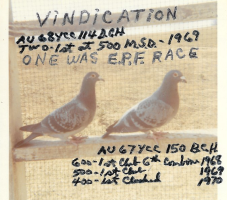
AU 68 YCC 114 D.C.H. (L),
1st at 500 M.S.D. and E. P. F.1969
AU 67 YCC 150 B. C. H. (R)
600, ist in club, 6th in combine, 1968
500, 1st in club, 1969
400, 1st clocked, 1970
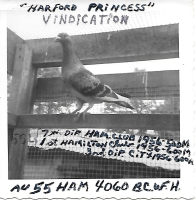
(AU 55 HAM 4060 B.C. U. F. H.)
7th DIP Hamilton Club 1956, 500 mi.
1st Hamilton Club 1956, 600 mi.
3rd DIP City 1956, 600 mi. 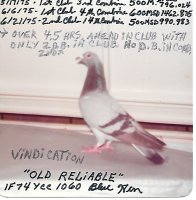
IF 74 YCC 1060 Blue Hen
5/17/75 1st in club, 3rd combine 500 mi, avg speed 796.024, over 4.5 hours ahead in club with only 2 day birds in club, no daybirds in combine
6/6/75 1st in club, 4th combine, 600 MSD, avg. speed 1462.835
6/21/75 2nd in club, 4th combine, 500 MSD, avg. speed 990.983
Over the years, dad often sold birds to other pigeon fanciers. Sometimes, during the height of his breeding, he would sell young birds that he didn't intend to fly at the Root's Country Market Auction (Note: Root rhymes with foot), where they were often bought by owners of upper class restaurants in New York City. One year in the late 1960's some migrant farm workers stopped to buy some birds to eat. That was the first time my siblings and I knew that people ate pigoens. The idea to us seemed comparable to eating rats, but that may have been due to our own distaste for having to take care of the pigeons.
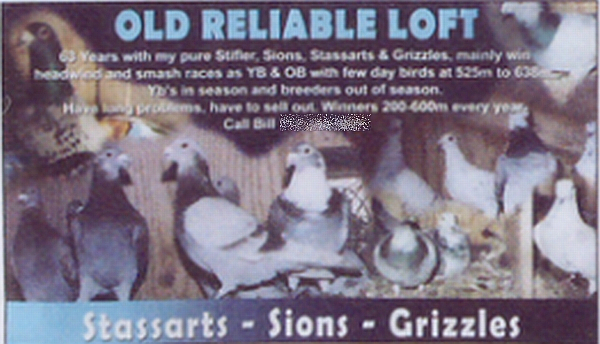
races as YB [young birds] and OB [old birds] with few day birds at 525 m to 635 m. Have lung problems.
Have to sell out. Winners 200-600 m. every year. Call Bill
In 1996, dad was interviewed for the July edition of the Racing Pigeon Bulletin, due to his outstanding record for winning races and for such a long and successful inbreeding program. I am thankful for that article, which helped me with some of the details about dad's racing and breeding history.
Source: "Not Older But Better." Racing Pigeon Bulletin. 51.2546, 7/1/1996, 12-13.
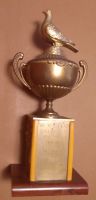
Spartansburg, S.C.
May 25, 1956
won by Wm. Stiffler
B.C.H. AU-53-YCC-3614
1267.73 yds. p. m. 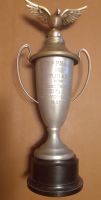
Stifler & Son
3rd Prize
500 mi. O.B.
AU-50-YCC-1124-B.c.c.
1108.57 yds.
Dad is buried with the trophy he was most proud of, his first place win in the 600 mile race when he was in the Hamilton Club in Maryland. He is interred at the Windsor Church of God cemetery on Manor Rd. in Lower Windsor Township. Two of my cousins, Greg and Tommy Greear came to the viewing and attached a pigeon pin they had found to my dad's lapel, a moving gesture and one my dad would have appreciated. Dad is also wearing his favorite tie, which features a blue bar pigeon.
Pictured to the left and right are two of dad's many trophies.
My dad has been the source of inspiration for a number of things that I have written over the years, including